
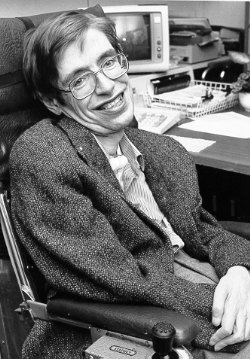

Stephen Hawking was a British theoretical physicist whose work on black holes and the origins of the universe made him the most famous scientist of his age. Diagnosed with motor neurone disease at 21 and given a few years to live, he defied the prognosis for five decades — producing landmark physics, writing A Brief History of Time, and becoming a global symbol of intellect triumphing over physical limits.
| Full Name | Stephen William Hawking |
| Born | 8 January 1942, Oxford, England |
| Died | 14 March 2018, Cambridge, England (aged 76) |
| Nationality | British |
| Occupation | Theoretical physicist, cosmologist, author |
| Known For | Hawking radiation, singularity theorems, A Brief History of Time |
| Net Worth (est.) | Around $20 million at the time of his death (estimates vary) |
Early Life and Education
Hawking was born in Oxford — on the anniversary of Galileo’s death, a coincidence he enjoyed — to Frank and Isobel Hawking, both university graduates. The family lived in St Albans, where he attended St Albans School. A bright but not always diligent student, he won a scholarship to University College, Oxford, at 17, graduating with a first-class degree in physics. He moved to Cambridge for a PhD in cosmology, drawn by the big questions about the beginning of the universe.
Diagnosis and Determination
At 21, after a fall while ice-skating, Hawking was diagnosed with amyotrophic lateral sclerosis (ALS), a form of motor neurone disease, and told he had roughly two years to live. The diagnosis initially plunged him into depression, but the slow progression of his disease — and his engagement to Jane Wilde — gave him purpose. He completed his doctorate, and as his mobility declined he worked increasingly through geometry and mental visualisation. After losing the ability to speak following a tracheotomy in 1985, he communicated through a cheek-muscle-controlled computer voice that became world-famous.
Black Holes and A Brief History of Time
Hawking’s scientific breakthroughs came in a remarkable run. Working with Roger Penrose, he proved singularity theorems showing that general relativity implies the universe began in a singularity. In 1974 he proposed that black holes emit radiation — ‘Hawking radiation’ — implying they slowly evaporate, a result that linked gravity, quantum mechanics and thermodynamics and remains a cornerstone of theoretical physics. With James Hartle he later proposed the ‘no-boundary’ model of the universe’s origin. In 1979 he became Lucasian Professor of Mathematics at Cambridge, a chair once held by Isaac Newton. His 1988 book A Brief History of Time stayed on best-seller lists for years and sold more than ten million copies, introducing cosmology to a mass audience.
Later Years and Public Life
Hawking remained scientifically active, famously losing public bets on black hole physics and gracefully conceding them. He experienced weightlessness on a zero-gravity flight in 2007, hoping to travel to space. His life was dramatised in The Theory of Everything (2014), for which Eddie Redmayne won the Academy Award. He co-wrote children’s books with his daughter Lucy and used his platform to warn about climate change, uncontrolled artificial intelligence and humanity’s need to colonise other planets.
Personal Life and Legacy
Hawking married Jane Wilde in 1965; they had three children — Robert, Lucy and Timothy — before divorcing in the 1990s. His second marriage, to Elaine Mason, ended in divorce in 2006. He died at home in Cambridge on 14 March 2018, aged 76, and his ashes were interred in Westminster Abbey between Newton and Darwin. His final paper was published posthumously, and his wheelchair and voice synthesiser are preserved as artefacts of scientific history.
Frequently Asked Questions
When did Stephen Hawking die?
He died on 14 March 2018 at his home in Cambridge, aged 76 — 55 years after a diagnosis that gave him about two years to live.
What disease did Stephen Hawking have?
Amyotrophic lateral sclerosis (ALS), a form of motor neurone disease, diagnosed when he was 21.
What is Hawking radiation?
His 1974 prediction that black holes emit thermal radiation due to quantum effects near the event horizon, causing them to slowly lose mass and evaporate.
What is A Brief History of Time?
His 1988 best-selling book explaining cosmology — black holes, the Big Bang and the nature of time — to general readers; it sold over ten million copies.
Related Biographies
Yuval Noah Harari and J.K. Rowling — more in our Doctors & Scientists and Authors & Thinkers collections.
Net worth and salary figures are estimates based on publicly available sources and may change over time.