
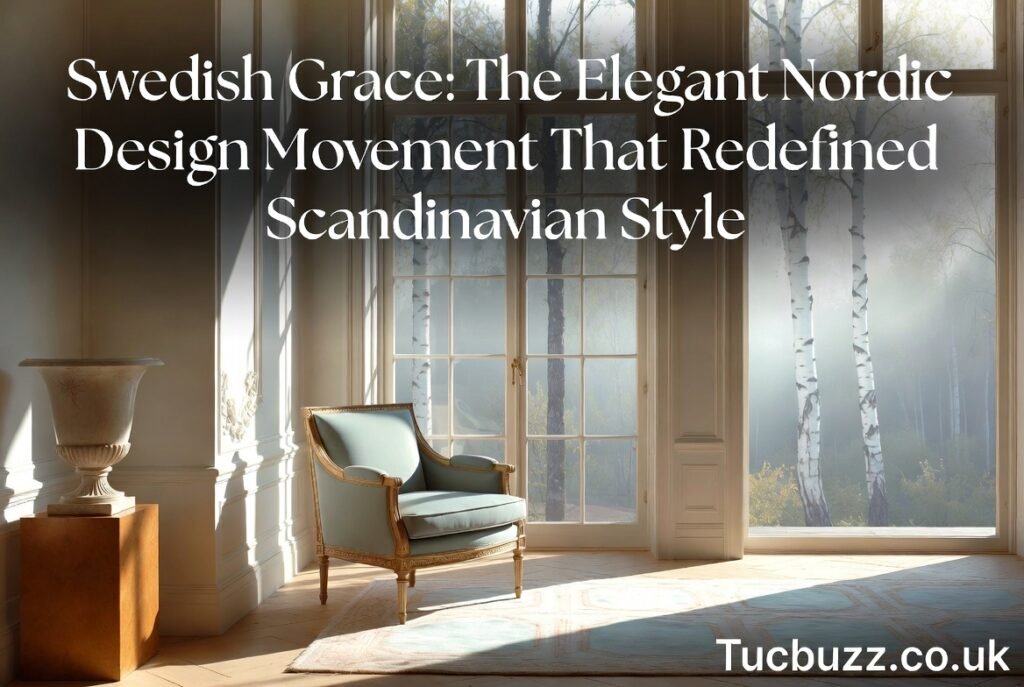

Swedish Grace is one of the most refined and intellectually rich design movements to emerge from Scandinavia in the early 20th century. Often described as a bridge between Nordic Classicism and modern Scandinavian design, Swedish Grace represents a unique moment in history when elegance, restraint, and craftsmanship came together in perfect harmony. Unlike heavily ornamented classical styles or the stark minimalism that would later define Scandinavian modernism, Swedish Grace focused on balance, softness, and quiet sophistication. It became a visual language that reflected Sweden’s cultural identity during a period of rapid social and artistic transformation.
The origins of Swedish Grace can be traced back to the 1920s, a time when Europe was recovering from the First World War and seeking new artistic directions. In Sweden, designers and architects began to reinterpret classical forms in a more simplified and harmonious way. This movement was deeply influenced by Nordic Classicism, but it gradually evolved into something more distinctively Swedish. The goal was not to reject tradition but to refine it, stripping away excess while preserving dignity and beauty in form and function.
Swedish Grace also gained international attention through exhibitions such as the 1925 Paris Exposition, where Scandinavian design was introduced to a global audience. The movement quickly became associated with cultural sophistication and national pride. It represented a new vision of modern living—one that valued craftsmanship, human scale, and artistic integrity. Today, Swedish Grace remains an essential reference point in design history, admired for its timeless elegance and its ability to connect past traditions with modern sensibilities.
Origins and Historical Background of Swedish Grace
The origins of Swedish Grace are deeply rooted in the cultural and artistic evolution of Sweden during the early 20th century. At the time, Sweden was undergoing significant social change, moving from a traditional agrarian society toward a more industrialized and modern nation. This transformation created a fertile environment for new artistic expressions that could reflect both national identity and contemporary aspirations. Designers, architects, and artists began seeking a style that would feel modern yet still connected to classical heritage.
One of the most important influences on Swedish Grace was Nordic Classicism, which itself drew inspiration from ancient Greek and Roman architecture but interpreted it through a Nordic lens. However, Swedish Grace refined this influence further by emphasizing elegance over grandeur and simplicity over strict historical replication. This shift marked a turning point in Scandinavian design history, as artists began prioritizing harmony, proportion, and emotional subtlety in their work.
The 1925 Paris Exposition played a crucial role in bringing Swedish Grace to international recognition. At this exhibition, Swedish designers showcased furniture, decorative arts, and architectural models that demonstrated a new aesthetic direction. Visitors were captivated by the movement’s understated elegance and technical craftsmanship. This global exposure helped establish Sweden as a serious contributor to modern design discourse, rather than a peripheral participant.
Swedish society itself embraced this new aesthetic with enthusiasm. Public buildings, homes, and everyday objects began to reflect the principles of the movement. It was not just a design trend but a cultural philosophy that emphasized beauty in daily life. Over time, Swedish Grace became a symbol of national pride, representing a uniquely Swedish interpretation of modernity that balanced tradition with innovation.
Core Characteristics and Design Principles of Swedish Grace

At the heart of Swedish Grace lies a commitment to harmony, balance, and refined simplicity. Unlike more decorative historical styles, Swedish Grace avoids excess ornamentation and instead focuses on proportion and form. Every design element is carefully considered, resulting in compositions that feel both elegant and restrained. This attention to balance creates a sense of calm sophistication that is central to the movement’s identity.
Material selection plays a significant role in defining Swedish Grace aesthetics. Designers frequently used natural materials such as light woods, marble, glass, and ceramics. These materials were chosen not only for their beauty but also for their tactile and sensory qualities. The goal was to create environments and objects that felt human-centered and authentic, rather than overly industrial or artificial. This emphasis on material honesty remains a defining feature of the style.
Color palettes in Swedish Grace design are typically soft and muted. Rather than bold or dramatic contrasts, the movement favors pastel tones, warm neutrals, and subtle variations in hue. These color choices reinforce the sense of calm and refinement that characterizes the style. Combined with gentle lighting and carefully proportioned spaces, the result is an atmosphere of understated luxury.
Craftsmanship is another essential principle of Swedish Grace. Designers worked closely with skilled artisans to ensure that every detail was executed with precision and care. Whether in furniture, textiles, or architectural elements, the human touch is always visible. This dedication to craftsmanship distinguishes Swedish Grace from mass-produced design trends and reinforces its timeless appeal in both historical and contemporary contexts.
Swedish Grace in Architecture and Interior Design
Swedish Grace had a profound impact on architecture and interior design, shaping the visual identity of many public and private spaces across Sweden. In architecture, the movement is characterized by a blend of classical symmetry and modern functionality. Buildings often feature clean lines, balanced proportions, and subtle decorative elements that enhance rather than dominate the overall structure. This approach creates spaces that feel dignified yet approachable.
Public buildings such as libraries, museums, and government institutions became key expressions of Swedish Grace principles. These structures were designed to reflect cultural values of order, beauty, and accessibility. Rather than overwhelming visitors with grandeur, architects aimed to create environments that felt welcoming and human-scaled. This philosophy helped redefine how public architecture could serve both aesthetic and social purposes.
In interior design, Swedish Grace introduced a new way of thinking about domestic spaces. Furniture pieces were designed with both comfort and elegance in mind, often featuring soft curves, fine detailing, and high-quality materials. Lighting played an important role as well, with designers using it to enhance atmosphere and highlight architectural features. Textiles and decorative objects were carefully integrated to maintain visual harmony throughout the space.
One of the most significant contributions of Swedish Grace to interior design is its lasting influence on Scandinavian home aesthetics. Many modern interiors still reflect its principles of simplicity, warmth, and craftsmanship. Even as Scandinavian modernism later shifted toward minimalism, the foundational ideas of Swedish Grace—balance, quality, and human-centered design—continued to shape how spaces are designed and experienced.
Legacy and Modern Revival of Swedish Grace
The legacy of Swedish Grace extends far beyond its original historical period, continuing to influence designers and architects around the world. As one of the most important transitional movements in Scandinavian design history, it laid the groundwork for later developments in modernism while preserving a sense of artistic richness. Its emphasis on elegance and craftsmanship remains highly relevant in today’s design landscape.
In recent years, there has been a renewed interest in Swedish Grace as part of a broader revival of classic and artisanal design values. Contemporary designers are rediscovering its principles and adapting them to modern contexts. This includes the use of sustainable materials, handcrafted furniture, and interiors that prioritize comfort and emotional well-being. The movement’s focus on quality over quantity aligns closely with current sustainability trends.
Swedish Grace also continues to influence luxury design and boutique hospitality spaces. Hotels, restaurants, and high-end residences often draw inspiration from its refined aesthetic to create environments that feel both timeless and contemporary. The style’s ability to balance tradition with modern sensibility makes it especially appealing in global design markets seeking authenticity and depth.
Ultimately, Swedish Grace remains a powerful reminder that design is not only about function or appearance but also about cultural expression. Its enduring appeal lies in its ability to communicate elegance without excess and sophistication without rigidity. As design continues to evolve, Swedish Grace stands as a timeless example of how beauty, craftsmanship, and meaning can coexist in perfect harmony.
Conclusion: Why Swedish Grace Still Matters Today
Swedish Grace continues to hold a significant place in design history because it represents a rare balance between tradition and modernity. It emerged during a transformative period in Sweden’s cultural development and succeeded in creating a visual language that was both nationally distinctive and universally appealing. Its emphasis on harmony, craftsmanship, and understated elegance has allowed it to remain relevant across generations.
Today, Swedish Grace serves as both an inspiration and a foundation for contemporary design practices. Whether in architecture, interior design, or decorative arts, its principles continue to guide creators who value quality and timelessness. In a world often dominated by fast-changing trends, Swedish Grace reminds us of the enduring power of thoughtful, human-centered design.
You may read: tucbuzz