
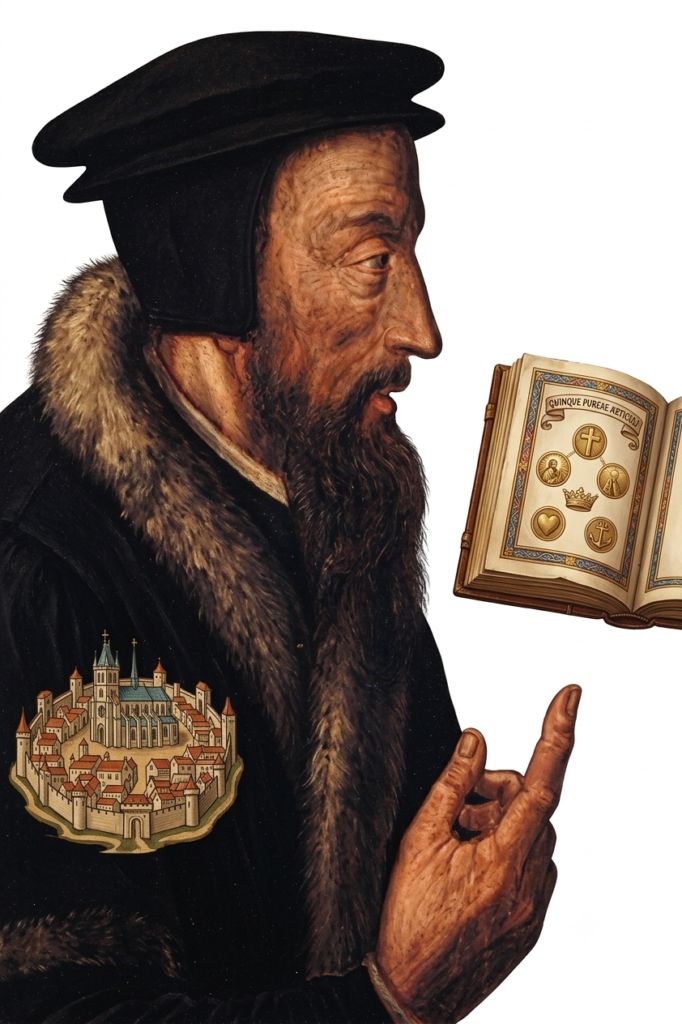

Calvin: A Biography — A Fresh Look at the Reformer
A review of Bernard Cottret’s Calvin: A Biography
A Crowded Field of Calvin Biographies
John Calvin has never lacked biographers, but the late 1980s produced an unusually rich cluster of them. Ronald Wallace situated Calvin’s life within a topical structure, tracing themes rather than a strict chronology. Alister McGrath took a more traditional path, narrating the life first and turning to Calvin’s ideas and influence afterward. William Bouwsma’s contribution stood apart from both: it became the most talked-about Calvin biography of a generation, generating debate well beyond academic circles and even drawing coverage in the mainstream press. Bouwsma’s central claim was provocative — that Calvin was pulled between two competing identities, a rigorous scholastic thinker on one hand and a humanist rhetorician on the other. He framed the whole project as an attempt to recover the “historical Calvin” from centuries of confessional shaping.
Bernard Cottret’s biography enters this conversation with a similar ambition to Bouwsma’s — to present Calvin as a genuine sixteenth-century figure rather than a polished confessional symbol — but pursues it in a far steadier, less speculative register. The result, according to reviewer Tony Lane, is a portrait less likely to spark controversy than Bouwsma’s, but considerably more dependable as history.
A Reformer, Not a Saint or a Dictator
One of the book’s strengths is its refusal to flatten Calvin into either hagiography or caricature. Cottret resists both the image of Calvin as an untouchable saint and the image of him as an authoritarian dictator. Instead, he places Calvin within the biblical prophetic tradition — a figure driven by conviction and calling rather than by sanctity or the pursuit of control.
An Evolving Thinker
Cottret also traces development in Calvin’s thought over time — though the reviewer notes this emphasis is not quite as novel as some promotional material suggested, since earlier biographies had touched on it too. Still, Cottret draws out the importance of Calvin’s period in Strasbourg with particular clarity, arguing that it was there that Calvin truly became “a Calvinist” in the fuller sense of the word.
The book also engages seriously with Calvin’s theology, even though Cottret’s primary training is historical rather than theological. On the Lord’s Supper, the reviewer questions whether Cottret’s language about a real, spiritual presence of Christ in the elements is fully accurate to Calvin’s actual position. On predestination — long the doctrine most associated with Calvin’s name — Cottret suggests that Calvin himself bears some responsibility for that later association, having become increasingly absorbed in polemical argument and, the biography suggests, a degree of authorial pride in his later years.
An Overlooked Point About the French Reformation
Among the biography’s more valuable observations is one about the French Reformation specifically: it was not the book of Romans and the doctrine of justification that most divided reformers from Rome in France, but rather the book of Hebrews and disputes over the Mass. This is a notable point, especially given that a measure of agreement on justification had already been reached at the Colloquy of Regensburg in 1541. The reviewer illustrates the stakes with the case of Reginald Pole, whose own views on justification were closer to the Reformers’ than to the Council of Trent’s, yet who nonetheless presided over the burning of bishops in Mary Tudor’s England over their eucharistic views.
Style and Translation
As a translated work, the book’s prose is uneven. Some passages read as contorted or unclear, a quality the reviewer suspects may trace back to the French original rather than the translation itself. Elsewhere, though, Cottret’s voice comes through vividly, with memorable turns of phrase that capture both the color and the excess of Reformation-era religious controversy.
A more practical frustration for scholars: citations of Calvin’s own writings are often difficult to trace, either because they are drawn from secondary sources without noting the underlying reference, or because they point only to a volume and column number in the Calvini Opera without specifying which work is being cited.
Where This Biography Fits
Cottret’s Calvin: A Biography doesn’t replace the biographies that came before it, nor does it try to. What it offers instead is a fresh, historically grounded portrait that stands alongside Wallace, McGrath, and Bouwsma as a distinct and worthwhile contribution — one shaped by careful historical work rather than confessional pleading or speculative psychology. For readers wanting to understand Calvin as a man of his own century, rather than as a symbol claimed by later movements, it’s a welcome addition to the shelf.
Based on a review by Tony Lane (London School of Theology), published in Themelios, The Gospel Coalition.